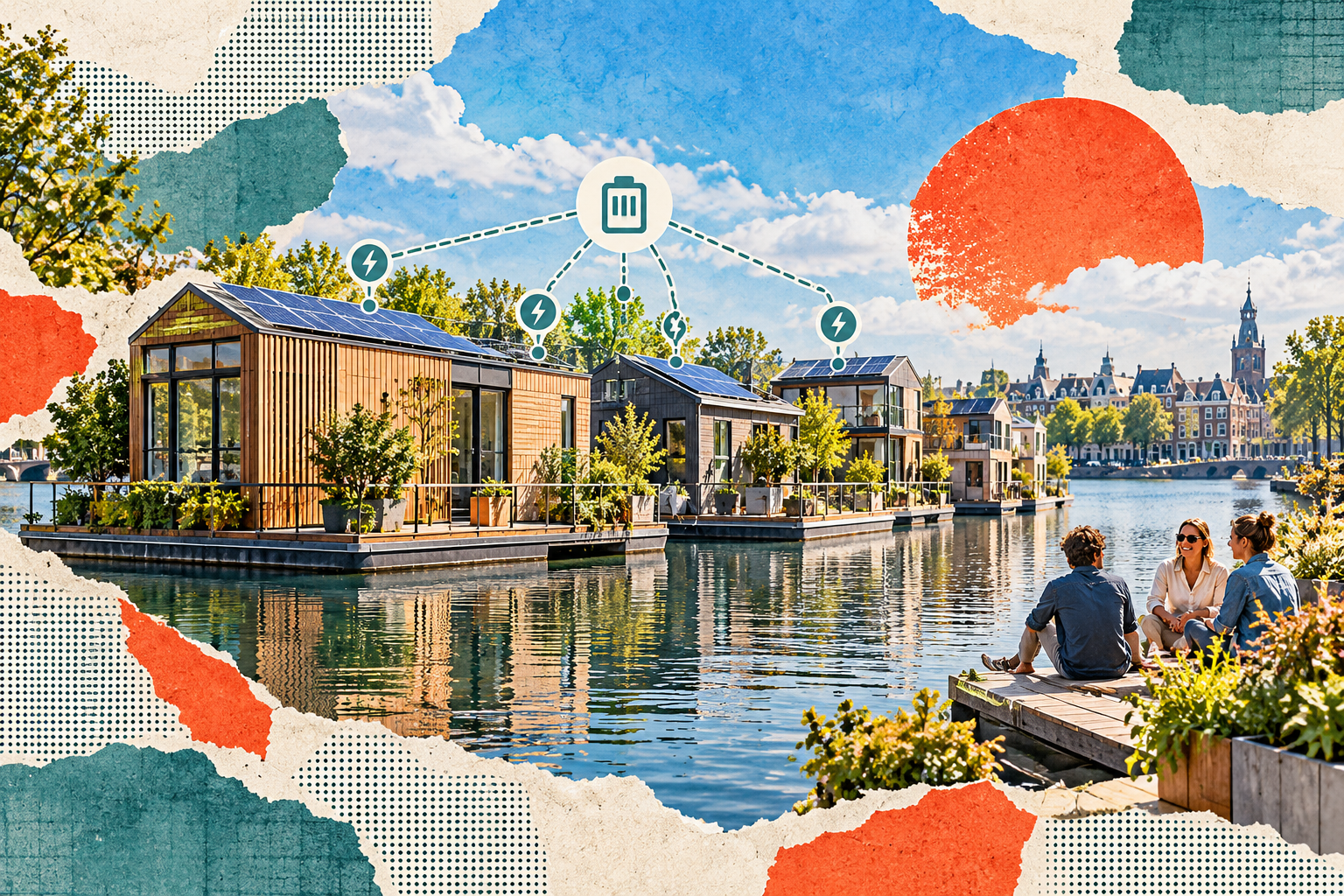
Amsterdam’s Schoonschip asks a practical question about the energy transition: what changes when neighbors plan homes and energy infrastructure together? In the city’s north, a community of 46 households lives on 30 floating structures along the Johan van Hasselt canal. Residents describe a shared local grid that connects their homes, alongside systems for generating and managing energy.
The project is a case study in community-led development, not evidence that a neighborhood can disconnect from the wider energy system. Schoonschip itself says its 46 households share one connection to the national grid. Its local generation, batteries, and energy coordination work within that connection.
A neighborhood organized by its residents
Schoonschip describes itself as a floating neighborhood in Amsterdam North. Its site says 15 of its 30 “arks” contain two households each, with a shared meeting space on one of the structures. The project’s community account describes an organizational journey from a foundation toward an owners’ association, with residents forming work groups around energy, sanitation, shared mobility, ecology, water quality, and communication.
That organization is part of the infrastructure. Shared systems require decisions about maintenance, investment, and how to coordinate different households’ needs. A local grid is not just equipment; it depends on people agreeing how to manage equipment and energy together.
Solar, storage, and a local smart grid
According to Schoonschip’s own description, homes generate electricity with photovoltaic panels, and each house has a battery to store temporary surpluses. The homes are connected to a smart grid that enables electricity exchange within the community. With 46 households, the group reports one connection to the national grid.
The design combines household-scale equipment with shared coordination. A home may produce electricity when sunlight is available, store some for later, and exchange energy with neighbors through the local system. But this arrangement does not establish that production always matches demand, that the community is energy-independent, or that it is carbon-neutral. Grid connection remains part of the picture.
Heat from the canal and efficient hot water
Schoonschip residents say their homes use heat pumps that extract warmth from canal water. They also describe passive solar heating, solar water heating, heat pumps for tap water, and heat-recovery systems in showers.
These measures can reduce reliance on conventional heating fuels, but the supplied project descriptions do not provide a complete, independently verified accounting of energy use or emissions. Performance depends on the systems’ operation, seasonal conditions, equipment, and the electricity that powers them. The project is best understood here as a set of integrated design choices, not a verified zero-carbon outcome.
Flexibility requires more than panels
Fraunhofer ITWM describes Schoonschip as an energy community with photovoltaic generation, batteries, and heat pumps whose operation can be coordinated against changing electricity prices. Its work calculates the community’s combined consumption and surplus, including household use, local generation, and heat-pump demand. Storage can be charged with lower-priced electricity and discharged during more expensive periods, according to planned schedules.
This account highlights an important point: a local grid’s value is not only the energy produced on roofs. It can also come from coordinating when electricity is used, stored, or shared. Fraunhofer’s description concerns the energy community and price-optimisation work; it should not be read as proof that the system has eliminated imports or achieved a particular emissions reduction.
Schoonschip’s own website also describes shared mobility as one of the residents’ work-group topics. Community coordination therefore extends beyond power to other shared infrastructure, though the sources cited here do not quantify mobility outcomes.
What makes the model hard to copy
Schoonschip offers lessons in combining physical systems with a resident-led organization. It also shows why replication is not simply a matter of buying batteries and installing panels. A similar development would need residents able to organize over time, clear ownership and maintenance responsibilities, compatible grid arrangements, financing, and rules for sharing decisions and costs.
Those requirements are practical questions rather than claims that the model cannot scale. They point to what another neighborhood would need to assess locally: who owns the infrastructure, how the wider grid connection works, how residents resolve disagreements, and who pays when equipment needs replacement.
Shared infrastructure, connected to a larger system
Schoonschip’s experiment is not about escaping the energy grid. It is about adding local generation, storage, and coordination within a community that remains connected to the national network. That distinction matters for realistic conversations about sustainable living.
The project’s most useful lesson may be that energy systems are social systems too. Community ownership and cooperation can shape how infrastructure is used, but claims about independence or climate impact need measured evidence. For another example of infrastructure designed around shared urban life, read our articles on Suita SST and Punggol Digital District.
Sources
- Schoonschip Amsterdam — community description of its households, structures, local grid, and resident work groups.
- Energy — Schoonschip Greenprint project site.
- Energy Community Schoonschip — Fraunhofer ITWM on coordinated generation, storage, and heat-pump operation.