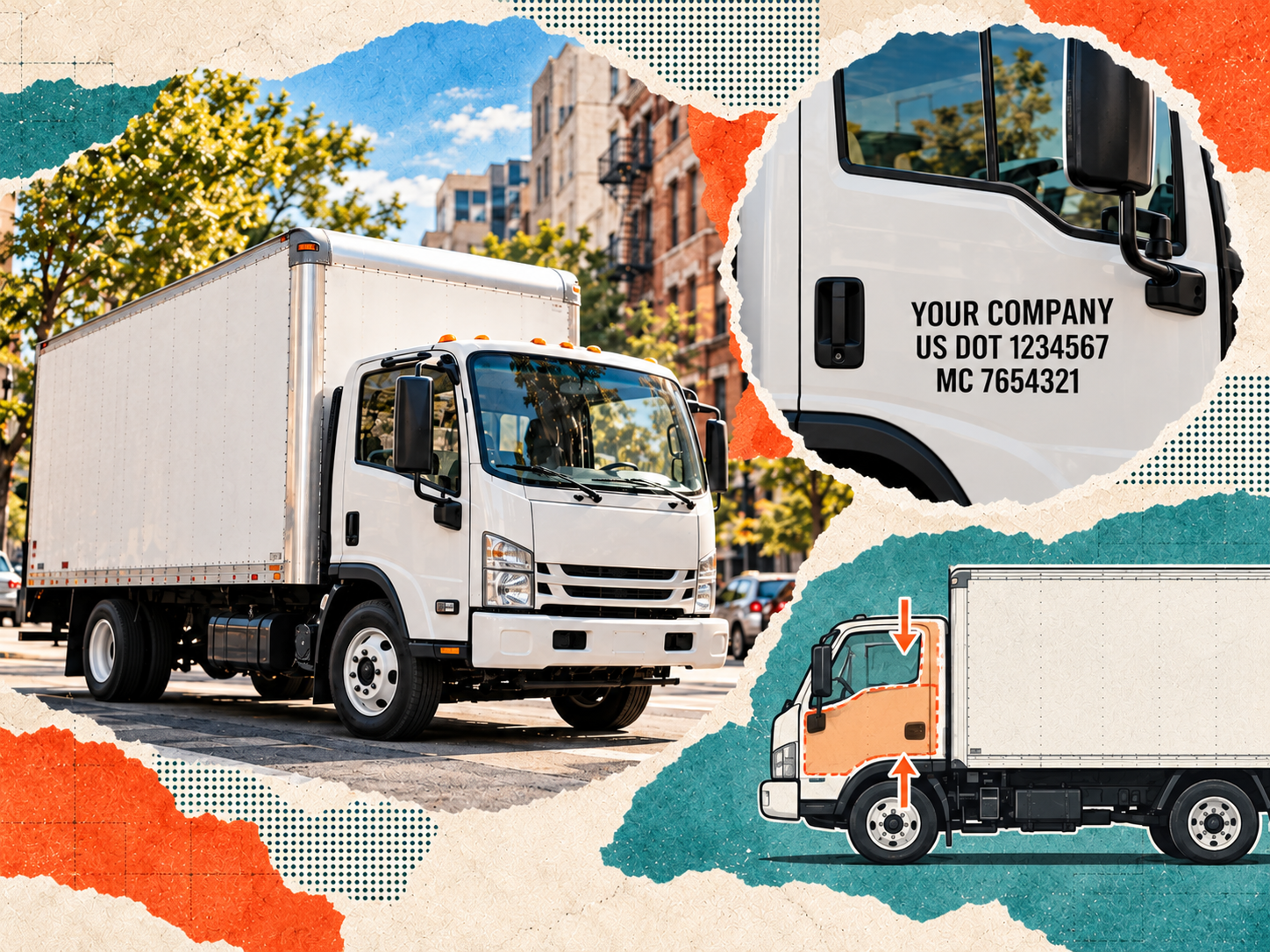
A box truck offers broad side panels, but that does not make every spot equally useful for a USDOT marking. Rear doors, lift gates, company graphics, seams, and loading equipment can all affect what is visible. The right starting point is the federal standard, then a careful look at the actual truck.
Under 49 CFR § 390.21, a covered self-propelled commercial motor vehicle must display its operating motor carrier’s legal name or a single qualifying trade name, plus the FMCSA-issued identification number preceded by “USDOT.” The marking must be on both sides, contrast sharply with the background, and be readily legible in daylight from 50 feet while the vehicle is stationary. It must be kept legible.
The rule speaks to both sides; it does not mandate a particular box-truck door or a universal minimum letter height. Applicability depends on the vehicle and operation, and the regulation includes specific arrangements for some rental, lease, and driveaway situations. Check the requirements that apply to your fleet.
Map the usable panel before ordering
Stand back and look at each side of the truck in its normal configuration. Identify a flat, unobstructed area that will remain visible while driving and will not be hidden by an open door, side-mounted equipment, a lift mechanism, or cargo. A side panel may be practical, but the best location depends on the truck’s dimensions and features.
Use measurements from the vehicle rather than a generic template. Record the available height and width on the left and right sides, noting seams, rivets, handles, reflective tape, and any existing graphics. A marking that crosses a panel joint may be harder to apply smoothly or keep readable. Check that both sides have room for the complete carrier name and number.
Treat rear-door markings as supplementary unless you have confirmed they meet the specific requirements for your operation. Section 390.21(c) says the required marking for a self-propelled CMV appears on both sides. A rear marking alone does not meet that placement language.
Design for contrast and legibility
Choose letter colors that contrast sharply with the surface underneath. A white box may make dark lettering easy to see; a dark-colored panel may call for a light design. But color alone does not settle legibility. Avoid ornate lettering, cramped spacing, excessive decoration, or placing required information over a busy image.
Check the full marking at a realistic viewing distance. The 50-foot daylight test in § 390.21 is an outcome standard, not a fixed type-size specification. Increase size or simplify the design if the carrier name or any digit is difficult to read. Recheck after installation from each side of the stationary truck and keep the marking clean and intact.
The name should be the operating carrier’s legal name or one qualifying trade name as reflected in the relevant FMCSA filing. The issued identification number must be preceded by “USDOT.” Verify those details against current carrier records before production. A logo or marketing slogan may accompany the required information, but it does not replace it.
For more detail on side placement across truck types, see where to display USDOT numbers on a truck. For the meaning of the federal lettering-size rule, see USDOT lettering size requirements explained.
If you are considering made-to-order box-truck graphics, view the box truck USDOT door decal listing on Etsy. DecalsMagicShop is owned by SafeSmart.city’s owner, so this is a commercial link. A purchase does not establish that the federal rule applies to your vehicle or guarantee legal compliance; confirm your marking requirements and check the installed result.
Sources
- 49 CFR § 390.21 — Marking of self-propelled CMVs and intermodal equipment, Electronic Code of Federal Regulations.