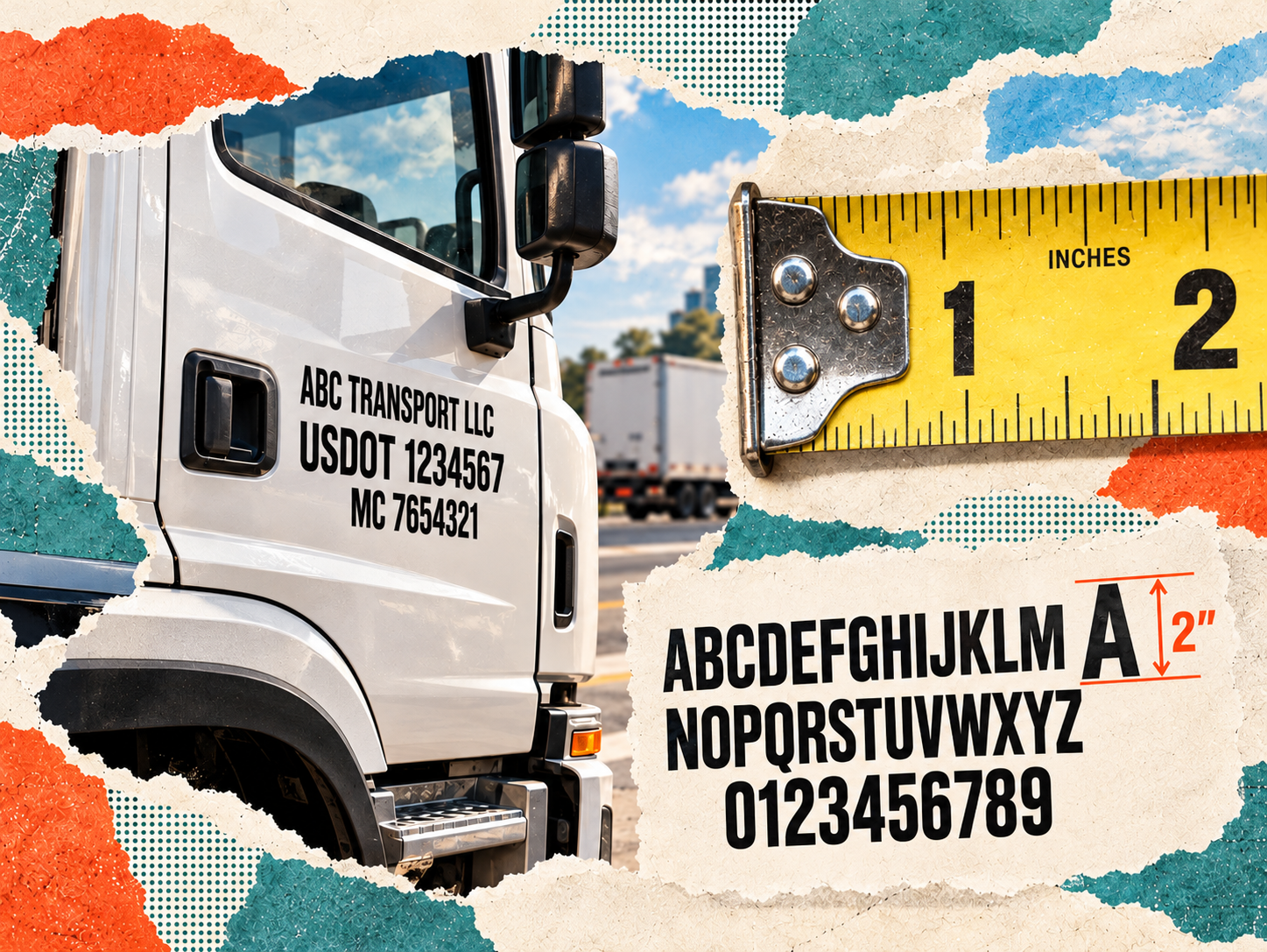
How tall do USDOT letters need to be? It is a common question, and a single-inch answer is tempting. But 49 CFR § 390.21 does not state one universal minimum letter height for the covered vehicle markings described there. Instead, it sets a practical legibility standard: the marking must be readily legible in daylight from 50 feet while the commercial motor vehicle is stationary.
That is not permission to use tiny type. It means the result matters: the required information must actually be readable at the specified distance and conditions. Vehicle shape, viewing angle, typeface, contrast, placement, and the condition of the marking all affect that result.
What must be legible
For a covered, self-propelled CMV, the marking must identify the operating motor carrier by its legal name or a single qualifying trade name and show the carrier’s FMCSA-issued identification number preceded by “USDOT.” Under § 390.21, it must appear on both sides of the vehicle, contrast sharply with the background, and be maintained so it continues to meet the legibility test.
The regulation’s 50-foot test is for daylight hours with the vehicle stationary. It does not prescribe a font, letter height in inches, decal brand, or one design that will work on every vehicle. A design that is technically large but crowded, distorted across a seam, or low-contrast may still be difficult to read.
The scope matters too. Section 390.21 applies to self-propelled CMVs subject to the applicable federal regulations and includes specific provisions for certain rentals, leases, driveaway services, and intermodal equipment. It is not a blanket rule for every privately owned or locally operated truck. Check the federal applicability rules and any state or local requirements for your operation.
Use the visibility test, not a guess
Treat the 50-foot distance as a test to perform after installation, not as a formula that automatically converts into one lettering height. Park the truck safely in daylight. From about 50 feet away, check that someone can readily read the carrier name and the full “USDOT” number on each side.
If a character is hard to distinguish, improve the design before relying on it. Common practical adjustments include increasing letter size, choosing simpler letterforms, adding stronger contrast, moving text to a flatter panel, and separating the name from other graphics. Retest both sides; a different panel shape or background can change the result.
The federal marking rule also requires the marking to be kept and maintained in a legible condition. Plan to inspect it after installation and during regular vehicle checks. Fading, damage, grime, peeling edges, or new equipment placed in front of the marking can reduce readability over time.
Avoid unsupported “minimum size” claims
Online advice sometimes states a fixed number of inches as though it appears in § 390.21. The text of that section instead gives the 50-foot legibility standard. Other rules, jurisdictions, contracts, or operational contexts may impose additional requirements, so do not assume this one section answers every marking question.
Use the carrier’s correct legal or qualifying trade name and current FMCSA number. A larger decal cannot fix an incorrect company name or number, and buying a particular product does not prove that the vehicle meets federal requirements. For placement on the vehicle itself, read where to display USDOT numbers on a truck. If the vehicle is a box truck, our box truck placement and design guide covers body-panel considerations.
For a custom design option, see the custom US DOT truck decals listing on Etsy. DecalsMagicShop is owned by SafeSmart.city’s owner; this is a commercial link. The listing is a product option, not legal advice or a guarantee of compliance. Confirm the applicable rules and test the installed marking yourself.
Sources
- 49 CFR § 390.21 — Marking of self-propelled CMVs and intermodal equipment, Electronic Code of Federal Regulations.